
Aladdin 5 FX EA V1.0 MQ4 – Trend-Following Precision for GBPUSD & USDJPY
If you’ve been hunting for an MT4 expert advisor that doesn’t overtrade, doesn’t get spooked by noise, and actually respects risk, Aladdin 5 FX EA V1.0 MQ4 is worth a very close look. Designed specifically for the GBPUSD M15 and USDJPY H4 combinations, this EA aims to read the market’s rhythm, wait for high-quality trend alignments, and execute with clean risk controls. No gimmicks, no magic—just structured rules that try to keep you on the right side of momentum.
What is Aladdin 5 FX EA V1.0?
Aladdin 5 FX EA V1.0 MQ4 is an automated trading system built for the MetaTrader 4 platform. It’s engineered to provide a robust, rules-based framework for trade execution. Instead of guessing, it analyzes price action and trend structure, checks volatility, and looks for moments where the risk-to-reward profile makes sense. When signals align, it places trades with predefined protections, then lets the strategy logic manage exits.
The EA is tuned for two clear operating lanes:
- GBPUSD on M15 for more frequent, intraday opportunities.
- USDJPY on H4 for higher-timeframe swings with fewer but cleaner signals.
This split gives you a nice balance—some short-term action on cable, plus a steadier, more deliberate pace on yen.
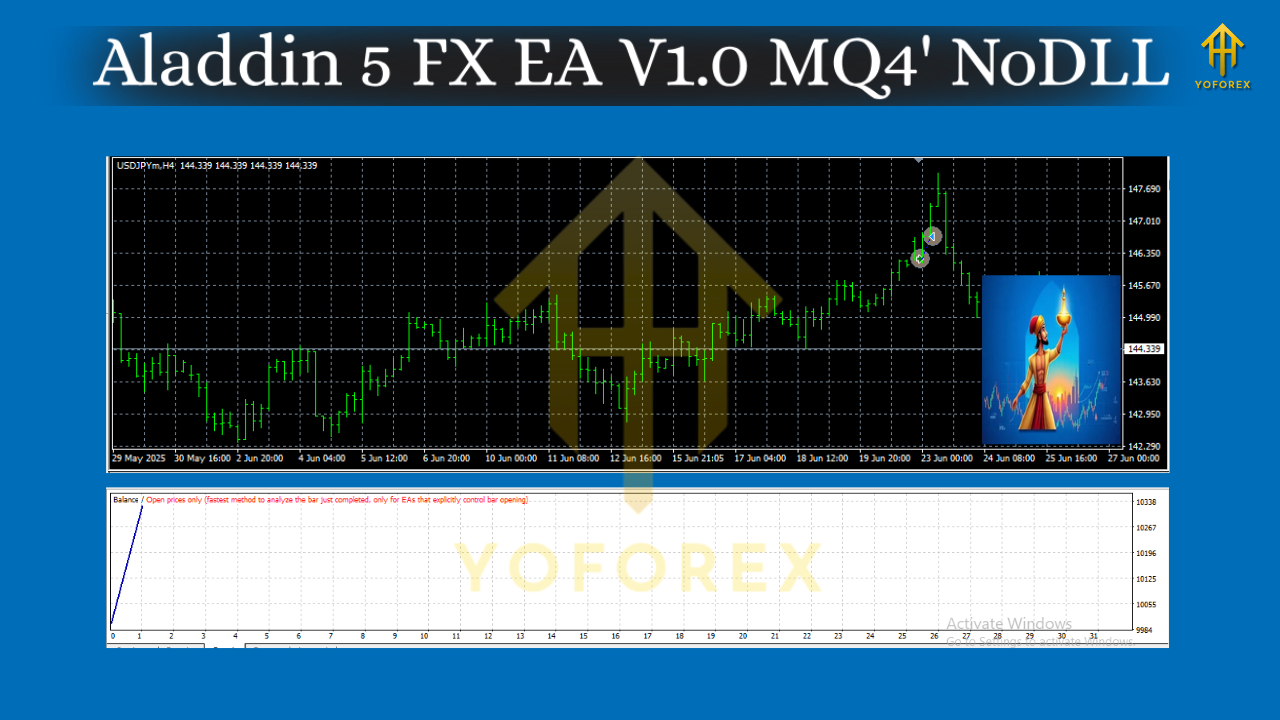
Core Approach & Philosophy
At its heart, Aladdin 5 FX is a trend-following EA with timing filters. It does not try to catch every wiggle. It waits for confirmation. It evaluates the slope and structure of price movement, couples that with volatility conditions, and then looks for a safe entry window. Protective stops are placed immediately. Depending on market behavior, exits can be fixed (TP/SL) or adaptive (trailing logic), helping the system lock gains while limiting downside.
The aim is simple: cut losers fast, let winners breathe, and avoid death-by-a-thousand-trades.
Why GBPUSD M15 and USDJPY H4?
Each pair and timeframe bring a distinct edge:
- GBPUSD M15
Cable can be lively during London and New York overlap. On M15, the EA can capture trend extensions and clean continuation moves after consolidations. You get a reasonable number of setups, which is helpful for compounding if risk is kept modest. - USDJPY H4
USDJPY tends to trend in prolonged waves, especially when macro themes drive flows. The H4 chart filters noise and focuses on structure. Signals are fewer, but they tend to be higher quality, allowing the EA to ride moves with fewer false starts.
Using both together helps diversify timing and trade frequency without juggling too many charts.
Key Features at a Glance
- Optimized lanes: GBPUSD M15 for intraday rhythm, USDJPY H4 for swing structure.
- Rules-based entries: Uses confirmation logic to avoid impulse trades.
- Protective risk controls: Hard stop-loss on entry; optional trailing stop for trend continuation.
- Volatility awareness: Filters to avoid thin or erratic conditions where spreads expand.
- Position sizing control: Fixed lot or risk-percent models, so you can tailor exposure.
- Trade management: Configurable take-profit targets with break-even and partial-close options (if you prefer scaling out).
- Session filters: Optional time windows to avoid rollover or low-liquidity periods.
- Broker-agnostic: Built for MT4; works with 4-digit and 5-digit pricing, ECN-style execution, and hedging accounts.
- Low maintenance: Once configured, it runs unattended—yet settings remain transparent and easy to adjust.
- Log clarity: Trade comments and Magic Number tagging for simple tracking across charts.
How the Signals Typically Form
While the exact recipe stays systematic, most entries share a pattern:
- Trend bias forms on the chosen timeframe (M15 or H4).
- Pullback or compression sets up a lower-risk entry zone.
- Momentum confirmation triggers the order, aligning direction and volatility.
- Risk is defined immediately by a protective stop beyond recent structure.
- Exit logic takes over—either a fixed target, or a trailing approach if the move extends.
This workflow reduces impulsive entries and helps keep average loss small compared to potential gain.
Suggested Risk & Money Management
No EA is a silver bullet. Your risk settings matter—big time.
- Risk per trade: Many traders prefer 0.5% to 1.0% per setup. Intraday M15 signals can be more frequent, so smaller risk per trade helps.
- Max simultaneous trades: Keep it modest. One pair per chart, one strategy per pair.
- Daily loss cap: Consider a 2% daily equity cap that disables new trades after a rough session.
- Weekly limit: A conservative 5% weekly cap adds another safety valve.
- Trailing stops: If you enable trailing, avoid setting them too tight—let the market breathe.
Consistent, disciplined risk sizing beats any attempt to “double down” after losses.
Installation & Setup (MT4)
- Add the EA to MT4: Copy the .mq4/.ex4 file into
MQL4/Experts, then restart MT4. - Chart assignment: Open GBPUSD (M15) and USDJPY (H4); drag the EA onto each chart separately.
- Enable trading: Check “Allow live trading” in the EA settings and in MT4’s global options.
- Inputs & risk: Choose fixed lots or risk-percent. Set stop-loss, take-profit, and trailing options per your plan.
- Filters: Configure session windows and maximum spread to avoid bad conditions.
- Magic Numbers: Use different Magic Numbers per chart so results stay neatly separated.
- Forward test first: Always test on a demo or low-risk environment before scaling up.
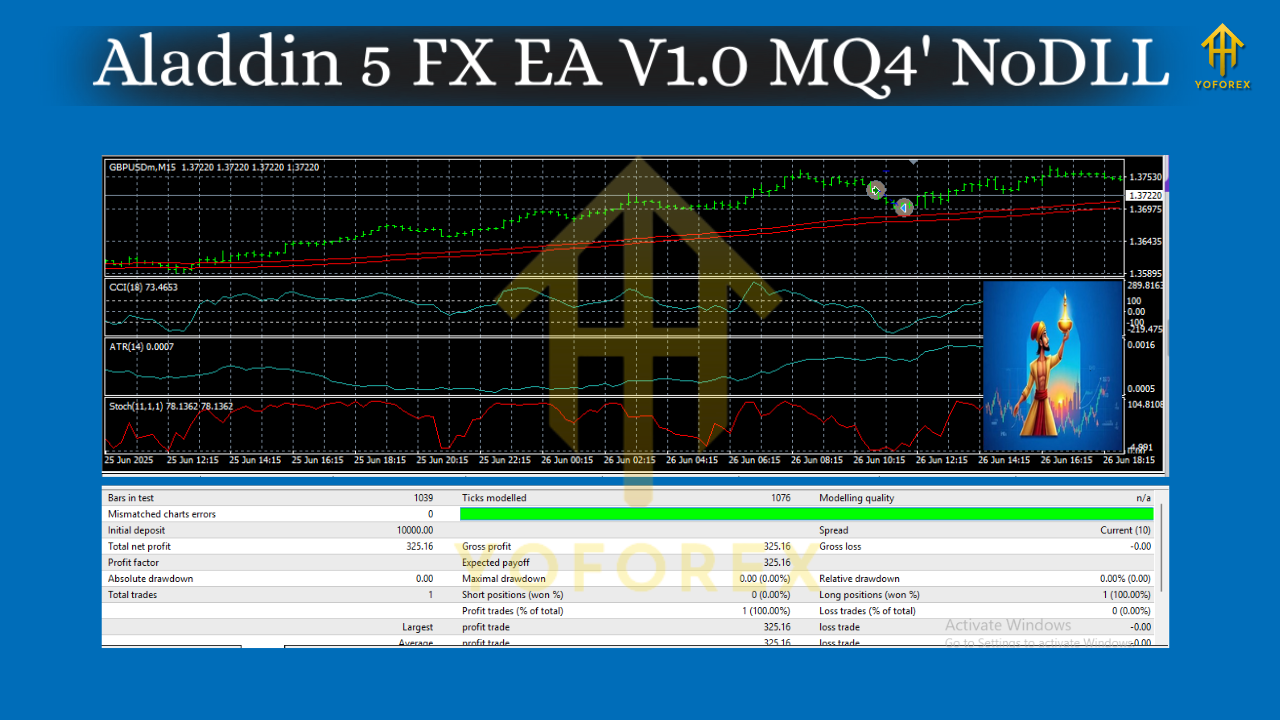
Best Practices for Running Aladdin 5 FX
- Use a reliable VPS: Stable connectivity and low latency reduce slips and missed trades.
- Stick to quality brokers: Tight spreads, fast execution, and consistent liquidity matter, especially on M15.
- Avoid news spikes: If you prefer calmer entries, enable time filters around high-impact events.
- Monitor equity, not just pips: Size and slippage can skew raw pip counts—equity curves tell the truth.
- Review weekly: Export statement, label trades, and confirm the EA is behaving as intended.
Backtesting & Forward Testing Tips
- Data quality: Use high-quality tick data if possible. Spread assumptions should match your broker.
- Walk-forward logic: Don’t overfit one date range. Validate across multiple market regimes.
- Out-of-sample testing: Reserve months you haven’t “optimized on” to see if results hold.
- Forward confirm: Let it run live on demo. Watch execution, slippage, and spread filters in real time.
Backtests are a sanity check. Forward testing proves viability under your exact broker conditions.
Who Is This EA For?
- Busy professionals who can’t babysit charts all day.
- System traders who prefer a rulebook over gut feel.
- Risk-first builders who want tight control over exposure and drawdown.
- GBPUSD intraday fans and USDJPY swing traders looking for a clean, two-chart workflow.
If that’s you, you’ll likely appreciate the EA’s calm temperament and respect for risk.
Final Word
Aladdin 5 FX EA V1.0 MQ4 doesn’t promise the moon. It promises structure. It looks for trend alignment, times the entry, protects the downside, and lets probability do the heavy lifting over a series of trades. Use sensible risk. Keep your expectations grounded. And give it room to execute the playbook it was designed for.


Comments
Thank you
Leave a Comment