
If you want a MetaTrader 4 Expert Advisor that prioritises capital protection, clean execution, and adaptable logic, AI MEDUSA EA V2.95 MT4 is built for that job. Rather than chasing quick thrills on ultra-low timeframes, it focuses on H1 entries with a portfolio mindset and disciplined exit rules. The goal is to keep losses small, let winners breathe, and avoid risky position-doubling patterns. This review is written for serious traders who care about forward-testing, broker conditions, and robust risk routines rather than flashy equity curves.
Why H1 and Why Now
Markets cycle through phases—trending bursts, range compression, and news-driven spikes. The H1 timeframe balances signal quality and frequency across those regimes. It filters intraday noise while still delivering enough opportunities when you monitor several pairs. AI MEDUSA leans on that balance, so stop loss and take profit placement make sense in real conditions, not just on paper. If you are upgrading from M5 or M15 scalpers, H1 will feel calmer and more manageable from a risk perspective.
Core Idea: Rules + Real-Time Adaptation
Think of the system as two layers. First, a rules layer that enforces protective stops, realistic targets, and breakeven logic so risk never drifts out of bounds. Second, an adaptive decision layer that evaluates context before committing. The practical effect is straightforward: each trade is independent, risk is pre-defined, and you do not rely on grid or martingale tactics to dig out of a hole. That design choice makes the equity curve steadier and easier to evaluate with real account statistics.

How AI MEDUSA Typically Manages a Trade
- Signal Observation: Price structure begins to align—momentum, pullback quality, and level interaction form a coherent picture on H1.
- Pre-Trade Filters: Spread, session, and minimum range criteria pass; no open conflicts with correlated pairs.
- Position Sizing: Lots are computed against an account-level risk cap. If you monitor multiple pairs, per-trade risk is scaled down to keep aggregate exposure tight.
- Order Placement: A market or stop order executes with a hard stop loss and a take profit aligned to volatility.
- Management: Once price advances, a breakeven or reduced-risk stop is applied. If momentum fades, the stop takes you out without debate.
Set-Up Checklist for MT4
- Install the EA in the Experts folder and restart MT4.
- Attach it to the recommended chart on the H1 timeframe.
- Enable Algo Trading and confirm you see tick activity in the Experts/Journal tabs.
- Review risk parameters (per-trade % risk, max concurrent trades, breakeven trigger).
- Add symbols you plan to trade to Market Watch and ensure your broker supports them with tight, consistent spreads.
- If you use a VPS, place it geographically close to your broker’s servers to cut latency and slippage.
Account & Risk Design That Actually Scales
A strong EA still needs a strong risk plan. Use a per-trade risk between 0.25% and 0.75% when you enable multiple pairs. For a single-pair focus you can go a bit higher, but cap daily loss at a fixed amount so you stop trading on bad days. Track these four numbers weekly: win rate, average win vs. average loss, profit factor, and max drawdown. Those metrics tell you whether the system is behaving or drifting.
Portfolio Construction: Smarter Pair Selection
AI MEDUSA’s edge improves when you curate a symbol list with modest cross-correlation. For example, mixing a dollar-heavy pair with a yen cross and one euro or commodity pair reduces the chance that all open trades react to one macro shock. A simple exposure rule helps: avoid opening three trades that all depend on the same currency’s direction. If two positions are highly correlated, reduce the second position size by half or skip it entirely.
Volatility, News, and Session Timing
H1 trades can survive minor data prints, but high-impact releases (CPI, NFP, central banks) can widen spreads and skip stops. If you are new to the system, reduce risk or pause trading around those events until you have forward-tested behaviour in your broker environment. London and early New York hours usually provide better liquidity and cleaner follow-through; late-session entries can stall.
Prop-Firm Readiness Without Drama
For evaluations, the system’s strength is rule discipline. Align your daily loss and overall drawdown limits with firm rules, reduce the number of simultaneous positions, and pick pairs that behave predictably during your allowed trading hours. Evaluation accounts punish even brief breaches, so let rules—not hunches—decide.
VPS and Broker Tech Details You Should Not Ignore
- Latency: Aim for sub-20ms to your broker if possible.
- Stability: Keep the terminal and VPS updated; schedule weekly restarts outside active sessions.
- Spreads & Swaps: Tight averages matter, but consistency is king. Review historical spreads at rollover, too.
- Execution: Note re-quotes or slippage clusters. If they persist, try a different server or contact support.
Troubleshooting and Quality Control
- Few or No Trades: Check Market Watch, symbol suffixes, and trading hours. Ensure H1 is selected and filters are not overly strict.
- Too Many Correlated Trades: Limit concurrent pairs or add a portfolio-level exposure cap.
- Stops Hit Then Price Runs: Widen stop placement slightly using an ATR multiple, or wait for higher-quality pullbacks before entry.
- Equity Curve Flatlining: Prune one or two underperforming pairs and reallocate risk to the stable performers.
Frequently Asked Questions
Do I need a VPS?
Strongly recommended. Stable connectivity keeps protective logic responsive and reduces slippage.
How much capital is enough?
You can start small, but if you enable multiple pairs, use smaller per-trade risk so margin stays comfortable and the system can ride normal H1 volatility.
Can I run it 24/5?
Yes, but results often improve when you bias activity to liquid sessions and reduce risk during high-impact news.
Is backtesting enough?
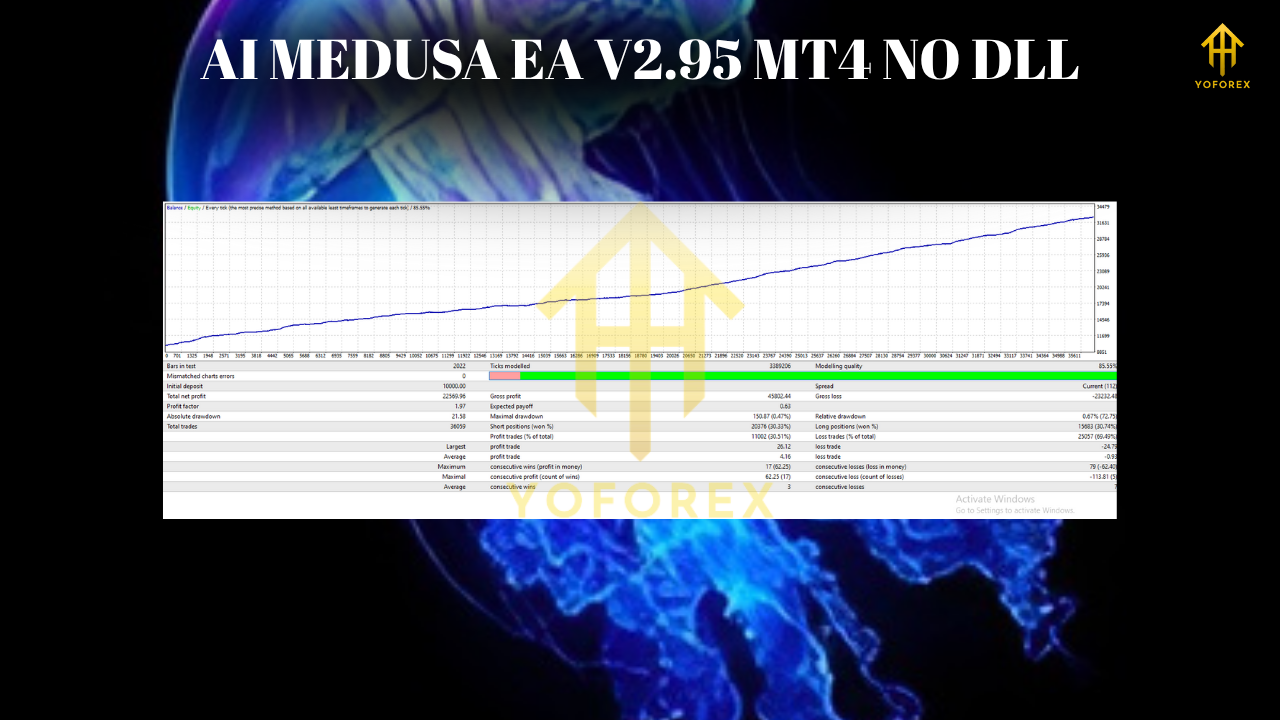
Treat backtesting as a rough guide. Your real edge shows up in forward-testing metrics from your broker with your costs and your latency.
Final Verdict
AI MEDUSA EA V2.95 MT4 fits traders who want clear rules, controlled risk, and portfolio-style diversification on H1. It avoids position-doubling tactics and keeps management logic tight—hard stops, realistic targets, and breakeven protection. To get the best from it, commit to a structured 30-day forward-test, choose a reliable broker, run a low-latency VPS, and track the four core metrics every week. The payoff is confidence: when you know your risk envelope and your system’s true behaviour, scaling no longer feels like a gamble.


Comments
No comments yet. Be the first to comment!
Leave a Comment